
TPLO Surgery · Cost & Pricing 2026
How much does a TPLO surgery for a dog cost in San Diego?
Reviewed by Dr. Jaroslaw Wypart, Chief Surgeon · Sept. 2026
If your dog has torn a cruciate ligament and TPLO surgery has been recommended, you may find yourself wondering about the price of the procedure. It’s easy to obtain a quote over the phone, the hard part is knowing whether those prices include the same things.
For those who look for a quick answer: at SurgiPet in Carlsbad, a complete TPLO package for one knee for the average size dog (below 90 lb) costs $4,950. The package includes the surgery, anesthesia, implants, two weeks of take-home medications, and routine follow-up care including rechecks and x-rays for 4 months.
The full price list, including weight brackets, is further down this page.
But before comparing that number with another TPLO quote, let's look at factors influencing TPLO surgery costs and answer some common questions.
What does a real TPLO invoice look like?
Below are the actual estimate and invoice from the same routine TPLO performed at SurgiPet in July 2026. The client's and patient's personal information have been removed.
Actual redacted invoice
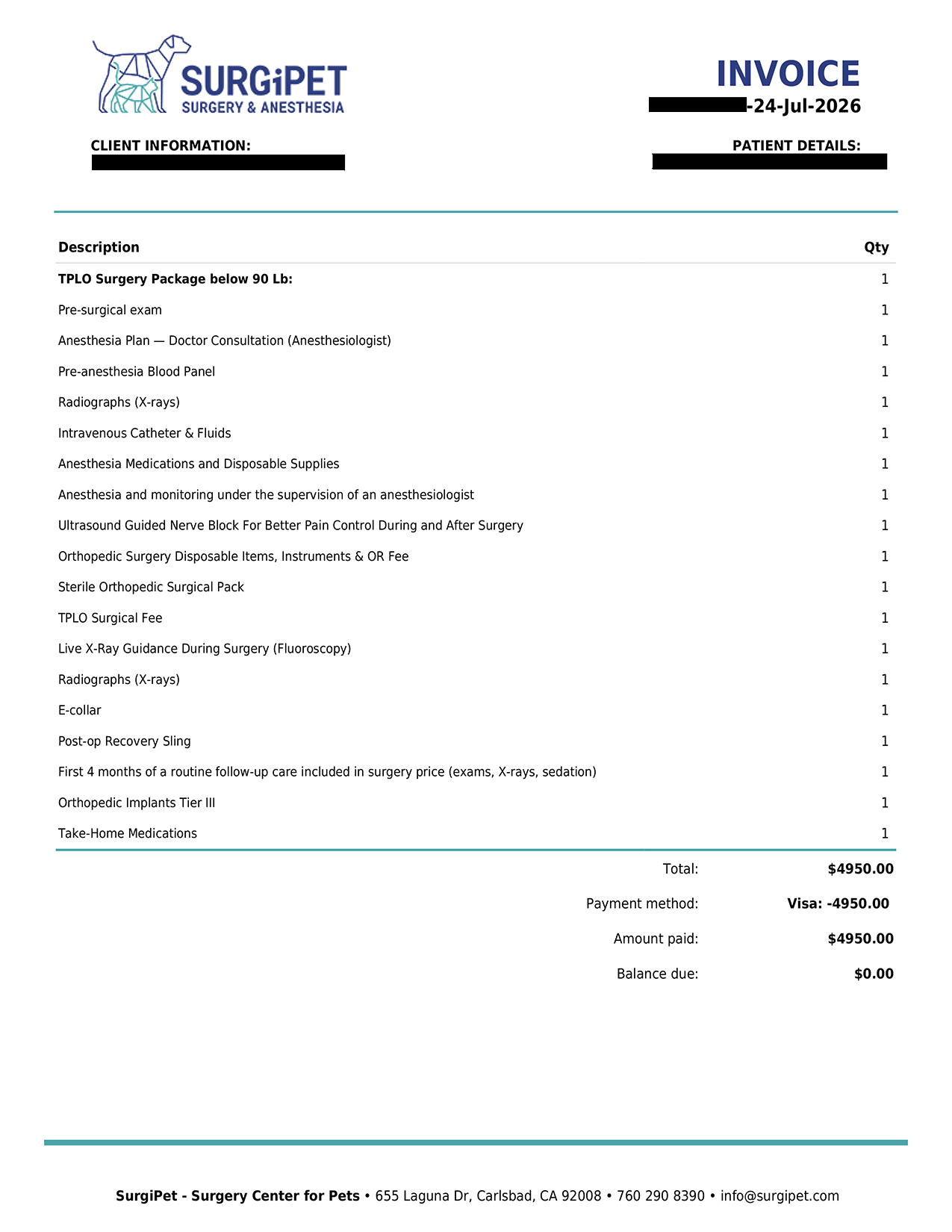
Invoice explained
Why does TPLO surgery cost vary?
There is no standard price for TPLO surgery in San Diego, and there is no rule about what TPLO quote has to include. In practice, quotes differ for a few concrete reasons.
1. Items included in the price.
Some hospitals quote one price that includes care from the consult through the final x-rays about 2 months after surgery. Others quote the surgery day only but charge separately for things like bloodwork, take-home medications, rechecks, and follow-up x-rays. Neither way is wrong, but the second one produces a smaller first number. For example, one owner showed us a quote of about $3,400. After clarifying a few more details, we learned that it did not include bloodwork, take-home medications, injection of pain medication, and recheck x-rays needed after surgery. Once we added them all, the approximate total was $4,375.
2. Your dog's size.
A bigger dog needs a bigger TPLO plate and larger or additional screws. In addition, the cost of medications is higher because medications are dosed by body weight. This is why many practices price TPLO by weight.
3. The surgeon's experience and availability before and after surgery.
The surgeon’s training, experience, and how often they perform TPLO can affect the price. It is also worth finding out how involved the surgeon will be before and after the operation.
Some hospitals employ their own surgeons. Others bring in a traveling surgeon on scheduled surgery days, which is often what makes orthopedic surgery available at a general practice you already know. Your regular veterinarian may handle the consultation, recheck visits, and questions during recovery. If a complication needs more advanced care, you may be referred to an emergency or specialty hospital and, if needed, its surgery department.
That arrangement may work perfectly well, but it means the surgeon who performs the TPLO may not be the doctor you meet before surgery or see for rechecks afterward. When comparing hospitals, ask:
- Who will actually perform my dog’s surgery?
- How often does that surgeon perform TPLO?
- Who will see my dog if there is a problem after surgery?
- Will I meet or speak with the surgeon before surgery, and is there a fee for that?
- Who will perform the recheck visits?
4. The type of anesthesia and who administers it.
Every TPLO requires general anesthesia, but anesthesia is not handled the same way at every hospital. Depending on the hospital, anesthesia may be managed by the surgeon, a veterinary assistant, a veterinary technician, or a board-certified veterinary anesthesiologist.
The number of people involved can differ too. At some hospitals, the person watching your dog during anesthesia may have other responsibilities, like helping prepare the surgical field or open instruments. At others, one team member has a single job during the operation: monitoring the anesthesia, and additional staff members are there to assist the surgeon.
Those models have genuinely different costs, and the difference shows up in the price. You will pay a higher anesthesia fee for an anesthesiologist than for an assistant or technician handling anesthesia. When comparing hospitals, it is reasonable to ask:
- Who is responsible for the anesthesia?
- Who watches my dog during surgery and while waking up?
- Who manages complications during anesthesia?
5. Joint evaluation.
Practices may examine the inside of the knee using an open approach, arthroscopy, or both. If arthroscopy is offered, ask whether it is included in the quoted price or charged separately.
6. Inpatient or outpatient surgery.
An outpatient procedure means that your dog is discharged a few hours after surgery versus requiring at least one night in the hospital, or an inpatient stay. With less invasive surgical techniques, new anesthesia techniques and modern pain control techniques like nerve blocks, dogs can walk comfortably and go home within 2-3 hours after surgery to rest in the comfort of their own home.
7. Who owns the hospital.
Corporate ownership is now common among veterinary hospitals nationwide. This matters in San Diego specifically: by our count, roughly 40% of veterinary clinic locations in San Diego County belong to corporate or investor-backed groups.† Research on veterinary consolidation has also found that consolidation can contribute to higher prices, particularly as competition within local markets decreases. Ownership isn't always obvious from a hospital's name, so if you are interested, it's reasonable to ask who owns the practice.
What should I ask when comparing TPLO prices?
When choosing where to have TPLO surgery, start with the care your dog will receive, then compare price. These are the questions that will help you compare 'apples to apples.' Keep them on hand while calling.
- Is this a complete package price or the surgery day only? What will the total be from consultation through final x-ray confirming healed bone?
- Is the consultation fee separate, and is it credited toward the surgery if we go ahead?
- Is pre-anesthetic bloodwork included, or is it charged separately?
- Are the x-rays needed before surgery included?
- Who monitors my dog's anesthesia and when they wake up, and do they do anything else during the surgery?
- What pain control is included? Are nerve blocks offered and if yes, are they charged separately?
- Which take-home medications are included, and for how long?
- Are routine recheck visits and recheck X-rays included? If my dog needs sedation for those X-rays, is that included too?
- If my dog needs an extra visit during recovery, who will see my dog, the surgeon or someone else? And are extra visits or X-rays included in the price?
- Does the price change based on my dog's weight, and where are the weight cutoffs?
You are not really comparing the same TPLO quotes until you know the answers.
What if both knees are torn? Bilateral TPLO costs.
Cruciate disease in dogs is usually due to slow weakening of the ligament rather than a single accident. That is why about 50% of all patients who tear one CCL will go on to tear the other, and it is not uncommon to examine dogs with both ligaments torn at the time of a consultation. That changes the cost significantly, so this scenario is included here. There are two main ways bilateral disease is handled:
1. Staged surgeries: one knee at a time.
The knees are operated on separately, typically 8-10 weeks apart. Each surgery is a full course of treatment: two anesthetic events, two recoveries, two sets of rechecks and recheck X-rays. The cost is essentially two full TPLO fees. But for many dogs, this makes the first part of recovery easier because they are not recovering from surgery on both back legs at the same time.
2. Single-session bilateral TPLO.
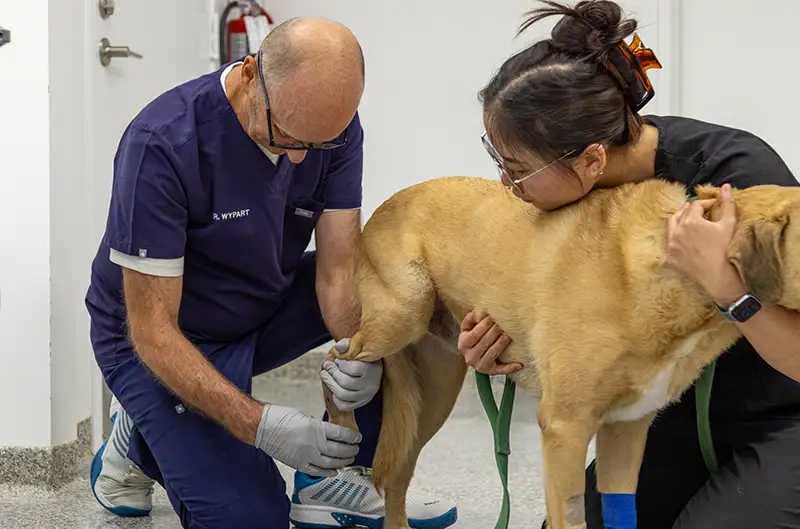
Both knees are operated on under one anesthesia. This saves the owner one anesthetic event and one set of preoperative work, and some practices discount the combined price accordingly.
The difficult part is the first few days afterward, because neither back leg is normal. A small dog in a one-story home may be manageable. A 100-pound dog that needs to go up and down stairs can be a very different situation.
Whether doing both knees at the same time is a good option should be discussed with the surgeon during the consultation. The decision depends on your dog's size, strength, temperament, home setup, stairs, flooring, and how much physical help you can provide during the first few days.
Will pet insurance actually pay for a TPLO?
Insurance coverage for TPLO surgery depends on your specific plan and whether your dog’s cruciate problem is considered a pre-existing condition. In most cases, TPLO surgery is covered by insurance. However, it is crucial you check these three things before you count on reimbursement:
- Pre-existing condition. If there is any note of limping or knee trouble in your dog's record from before the policy started, expect the insurer to treat the knee as pre-existing.
- Waiting periods. Many policies apply a special waiting period to cruciate or orthopedic conditions. Check whether yours has passed.
- Pre-authorization. Call your insurer before you schedule and ask them to review the estimate and to confirm coverage in writing. It is the only way to know your number in advance.
- What happens if the other knee tears later? This is especially important with cruciate disease because it often affects both knees. Insurance companies do not all handle the second knee the same way. Only a few policies may cover a later tear in the other knee when the first knee was covered, while most do not cover the second surgery. So ask your insurance company directly: If my dog later tears the cruciate ligament in the other knee, will that surgery be covered?
What if I can't pay for it all at once?
Financing is optional, but if you think it would help, you can consider the two commonly used providers for veterinary care: CareCredit and Scratchpay. You can check your options directly with either company before scheduling a consultation or surgery. The lender, not the veterinary hospital, decides whether you are approved, what interest rate you receive, and what payment plans are available.
CareCredit is a healthcare credit card. For a purchase the size of a TPLO, it offers fixed monthly payment plans over several years. CareCredit's site has a payment calculator you can use to estimate a monthly payment for a specific amount and term before applying.
For example, using a $4,950 TPLO:
Scratchpay offers fixed payment plans rather than a credit card. Scratchpay states that checking your eligibility does not affect your credit score. Scratchpay currently lists 12- and 24-month plans, with rates based on your specific application. Scratchpay has payment plan checker you can use to check your options.
If you're not approved by either lender, some local credit unions and banks offer personal loans or lines of credit that you can use for veterinary expenses. Terms are set by each institution, so compare more than one.
If financing determines whether TPLO fits your budget, check your options before scheduling. You don't need any paperwork from a veterinarian to apply, and veterinary hospitals play no role in whether you qualify.
Is there a cheaper surgery than TPLO?
Sometimes, honestly, yes. Lateral suture stabilization (LSS) repair (also called an extracapsular repair) stabilizes the knee with a strong suture instead of cutting bone, costs relatively less, and remains a reasonable choice for some smaller, less active dogs. TPLO provides much better stabilization and faster recovery which is why it is the usual recommendation for active dogs of any size. The right surgery depends on your dog's size, age, activity, examination, and X-rays. It should be an exam-room decision, not simply a pricing decision.
If age is one of your concerns, see how to assess whether an older dog is a TPLO candidate.
What is included in SurgiPet's TPLO price?
At SurgiPet, our TPLO surgery price is a flat-fee package price. Some dogs need more of one item than another: two nerve blocks or three, sedation for the recheck X-rays or none. The price is the same either way. It includes:
- Surgical examination and consultation
- Exam and assessment by our anesthesiologist before surgery
- Bloodwork before anesthesia
- X-rays of the knee on the day of surgery
- General anesthesia directed by a board-certified veterinary anesthesiologist
- Anesthesia monitoring by a dedicated, qualified team member from the first injection until your dog is fully awake
- 2 or 3 ultrasound-guided nerve blocks
- TPLO surgery (surgeon's fee)
- Live X-rays during surgery to confirm optimal plate and screws placement
- Implants: TPLO plate and screws (Titanium for all patients below 120 lb.)
- Two weeks of prescribed take-home medications
- E-collar
- Recovery sling
- Routine recheck visits for 4 months
- Recheck X-rays (to assess bone healing around 8 weeks after the surgery)
- Sedation for those X-rays if needed
Surgery without a Hospital Stay.
With less invasive surgical techniques, modern anesthesia, and nerve blocks, our TPLO patients go home within several hours of surgery. They walk out on their own to rest in the comfort of their own home, with you by their side.
Optional knee arthroscopy.
Every TPLO includes an examination of the inside of the knee. In the standard procedure, the surgeon examines the joint through a small opening and checks the meniscus and other structures inside. Knee arthroscopy is available as an optional add-on for an additional fee. It uses a small incision through which a surgeon passes a small camera to inspect a magnified view inside the joint.
Arthroscopy is not required for the TPLO itself and standard TPLO package already includes open inspection of the joint, including evaluation of the meniscus.
What is not included?
The package does not include:
- Physical therapy
- Medications needed after the first 2 weeks
- Treatment of complications
- Rechecks more than 4 months after surgery
- Unrelated tests, treatment, or procedures (i.e. hernia repair, mass removal, etc.)
Who will perform my dog's TPLO?
Just like in a human hospital, every TPLO at SurgiPet involves two doctors, not one: one doctor operates, and a separate doctor is responsible for the anesthesia.
Dr. Jaroslaw Wypart, SurgiPet's founder and chief surgeon, performs the surgery. He has more than 20 years of experience in orthopedic and soft tissue surgery and performs more than 250 TPLO surgeries each year.
The second doctor is Dr. Margaret Wypart, a board-certified veterinary anesthesiologist who specializes in anesthesia and pain management. Only about 1 in 100 U.S. veterinary practices have a board-certified anesthesiologist on staff.‡ This means every SurgiPet patient benefits from a doctor whose entire specialty is anesthesia: she examines your dog, develops an individualized anesthesia plan, places the ultrasound-guided nerve blocks that control pain, and directs and supervises the anesthesia throughout the procedure.
What does TPLO surgery cost at SurgiPet in 2026?
Open 8am to 6pm, seven days a week.
After hours, request an appointment and we'll contact you to confirm a time.
† Our estimate, August 2026: a 2025 Western University of Health Sciences research project on veterinary care availability in San Diego County, which identified ~308 veterinary clinics, and 132 San Diego County locations listed in the Private Equity Vet database (privateequityvet.org).
‡ Our estimate, based on figures published by the AVMA: 348 active ACVAA diplomates (board-certified veterinary anesthesiologists) in 2023, and 34,296 US veterinary practices in the same year, a US Census Bureau count reported by the AVMA